Number Guru
September 4, 2025 at 11:51 PM
September 9 2025 (Morning Aspiration)
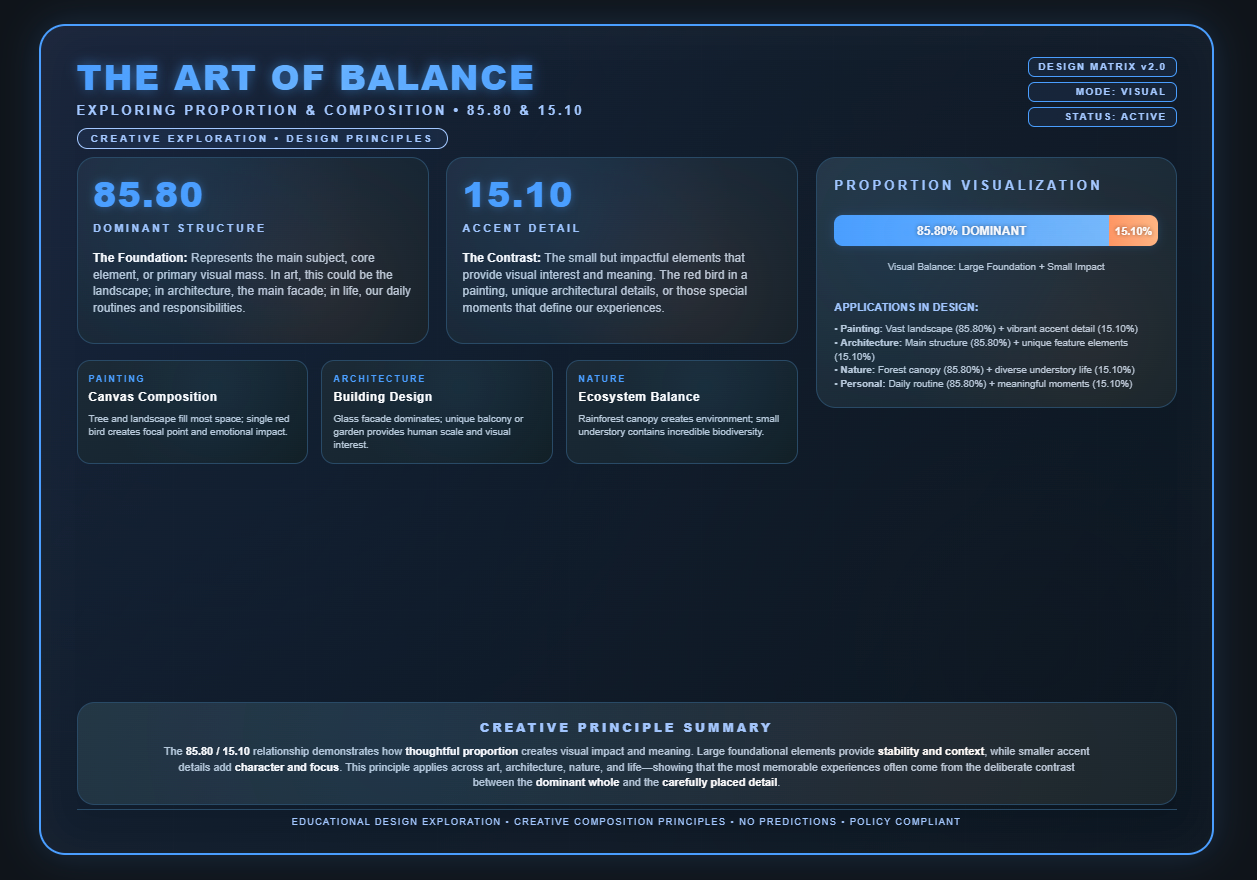
The Art of Balance: Exploring the Meaning Behind the Numbers 85.80 and 15.10
In a world filled with data points, algorithms, and complex systems, it's easy to overlook the simple beauty hidden within numbers. Yet, as artists, scientists, and thinkers have shown us, numbers can tell a story—not of fate or future, but of proportion, balance, and design. Today, let's explore two seemingly random values, 85.80 and 15.10, and see how they can be used to create compelling and thought-provoking content, all while adhering to a framework of creativity and factual exploration.
This article does not contain or endorse any form of fortune-telling, numerology, or astrology. Instead, we use these numbers as a creative prompt to discuss concepts of balance, composition, and human perception.
The Painter and the Proportions
Imagine a renowned painter, known for his ability to capture emotion and movement with a single brushstroke. For his latest masterpiece, he decides to challenge himself by using only two primary proportions: 85.80% and 15.10%. His goal is to create a piece that feels both expansive and focused, a study in how a small, deliberate detail can influence an overwhelming whole.
He starts with a vast canvas. He decides that the core subject of his painting—a solitary tree on a windswept hill—will occupy roughly 85.80% of the total visual space. He uses a rich, deep color palette for this part: dark greens, earthy browns, and a swirling gray sky. This large area dominates the eye, pulling the viewer into the scene and establishing a sense of grandeur and scale.
The remaining 15.10% is where the artist truly shows his genius. He uses this small percentage to paint the delicate, striking details that make the piece unforgettable. A single, vibrant red bird perched on a branch, a streak of bright yellow sunlight breaking through the clouds, and a tiny stream of water shimmering at the base of the hill. These small, meticulously placed elements provide a powerful counterpoint to the dominant tree. They draw the viewer’s attention, guiding their eye through the vast landscape and highlighting the importance of the smaller, often-overlooked details.
The painting's success is not about the numbers themselves, but about what they represent: a mindful use of space. It demonstrates that the most impactful moments are often found in the deliberate contrast between a dominant subject and a powerful, complementary accent. It’s a beautiful metaphor for life itself—the vast majority of our time is spent on the ordinary, but it's the small, special moments that truly define our experience.
From Canvas to Architecture: Building with Balance
The principles of composition aren't limited to a painter’s canvas. They are fundamental to architecture and design.
Consider a modern building design. The architect could use the 85.80 / 15.10 principle to great effect. Imagine a sleek skyscraper where the main facade, made of glass and steel, occupies 85.80% of the building’s exterior. This gives the building its primary identity and a sense of strength and uniformity.
The remaining 15.10% could be dedicated to creating visual interest and human scale. This could be a striking asymmetrical balcony structure, a unique geometric pattern etched into the corner panels, or a small, vibrant garden space on a lower level that adds a splash of color and life. This thoughtful use of a minor proportion prevents the building from becoming a monotonous monolith. It shows that even a small design element can break up a large space and add a layer of complexity and beauty.
This design philosophy is present in some of the most famous architectural works in the world. The stunning effect of the Louvre Pyramid in Paris, for instance, comes from its small, glass structure contrasting sharply with the grand, traditional palace it serves. It’s a masterful use of architectural juxtaposition, proving that a minor element can have a major impact.
A Scientific Analogy: The 85.80 / 15.10 Ratio in Nature
Beyond art and architecture, these proportions can also serve as a useful analogy for natural phenomena and scientific concepts. For instance, consider the composition of a rainforest.
The canopy of a tropical rainforest—the dense, uppermost layer of trees—is responsible for creating the forest's microclimate. It blocks out the majority of sunlight and rain, allowing only a small amount to filter down to the forest floor. You could argue that the biomass and leaf area of this canopy occupies a significant percentage of the rainforest's total ecosystem, perhaps in a proportion similar to 85.80%. This massive, overarching structure is what gives the rainforest its power and identity.
But what about the remaining 15.10%? This is the smaller, yet incredibly diverse, world that exists beneath the canopy. It's where the most unique and varied species of plants and animals live, where the fungi and bacteria thrive, and where the most complex interactions occur. This small percentage of the ecosystem is home to an astonishing array of life, proving that size isn't everything. It's a powerful reminder that some of the most important and biologically rich parts of an ecosystem are often found in the smallest spaces.
This concept extends to other areas of science as well. In oceanography, a vast majority of the ocean's volume is made up of the "twilight zone," a deep, dark layer that receives little to no sunlight. Yet, the small, sunlit upper layer—the top 15.10% or so—is where most of the marine biodiversity exists, supporting nearly all of the world's fisheries and ocean life. It is the small, vibrant part of the ocean that powers the massive, deep unknown.
In Our Own Lives: The Balance of Effort and Impact
Finally, these numbers can offer a helpful perspective on our own lives and work. We often spend the majority of our time—the 85.80%—on a core set of tasks: our jobs, our routines, and our daily responsibilities. These activities form the foundation of our lives and are necessary for stability. They are our "main subject" or "dominant structure."
But what about the remaining 15.10%? This is the time we can dedicate to the small, impactful things that make life meaningful. It might be an hour spent learning a new skill, a few minutes of quiet meditation, or a short phone call to an old friend. These small, deliberate actions are the "accents" that bring our lives to life. They can recharge our batteries, inspire new ideas, and create lasting memories that provide a powerful contrast to the everyday routine.
Thinking about our time in this way can help us to be more mindful of how we allocate our energy. It’s a reminder that dedicating a small portion of our day to something we are passionate about or something that brings us joy can have an outsized impact on our overall well-being. It’s about creating a balance between the essential and the enriching, allowing the small moments to add color and purpose to the larger picture.
In the end, the numbers 85.80 and 15.10 are just that—numbers. But when we view them through a lens of creativity, art, and science, they transform into powerful symbols of balance, contrast, and the outsized impact that a small, well-placed detail can have on a larger whole. They remind us to not only appreciate the big picture but to also seek out and cherish the small, vibrant details that make everything worthwhile.